⚔️ The Code Forge ⚔️
Light
Dark
System
AI & Machine Learning

Building Production AI Systems

From enterprise document intelligence at Hyland to multi-provider LLM infrastructure and RAG-powered chatbots — AI is the sharpest edge in my toolkit.

7+LLM providers supported
4+Production AI systems
M+Documents processed
4+Years AI experience

How I Build AI Systems

At Hyland I build agentic AI that powers enterprise document workflows for Fortune 500 companies. Users describe what they need in plain language — the agentic layer interprets intent, reasons over available tools via function calling, and generates low-code configurations without manual wiring. Document intelligence pipelines handle categorization, extraction, and classification at scale, with confidence scoring and human-in-the-loop checkpoints where the stakes are high.

Outside of Hyland, I built a production LLM proxy server that unifies seven providers — OpenAI, Anthropic, Azure AI Foundry, AWS Bedrock, Groq, and local models — behind a single .NET Core API. It tracks spend in real time and routes each request to the most cost-effective model for the task. The same cost-optimization thinking applies to every RAG system I design: right chunking strategy, right retrieval depth, right model tier.

My RAG work ranges from the ChromaDB-backed vector search powering this portfolio chatbot to pgvector integrations on Postgres for production systems. I approach vector databases as infrastructure — choosing between them based on operational requirements, not hype. The result is AI features that ship, scale, and stay within budget.

How I Integrate AI

Architectural patterns behind the production systems — from cost-optimized LLM routing to document intelligence pipelines and RAG search.

Multi-Provider LLM Architecture
Client Request
Unified API Layer.NET Core Proxy · Auth · Rate Limiting · Cost Tracking
Intelligent Routertask type · cost budget · quota · fallback
Free / Ultra-Low
Groq$0.00005
Ollama$0.00
Mid Tier
Azure AI$0.003
AWS Bedrock$0.003
CustomVariable
Premium
OpenAI$0.015
Anthropic$0.015
Document Intelligence Pipeline
UploadPDF · DOCX · Image
OCRTesseract · local
LLM Enhancementlayout · entities · tables
Structured OutputJSON schema · typed fields
StorageDB · vector index
Local processingCloud AI
RAG Pipeline
User Querynatural language
Embeddingtext-embedding-3
Vector SearchChromaDB · pgvector
Context Assemblytop-k · rerank
LLMGPT-4 · Claude
Streaming ResponseSSE · citations

AI Projects

Production systems built with modern LLM tooling across enterprise and personal contexts.

🏭

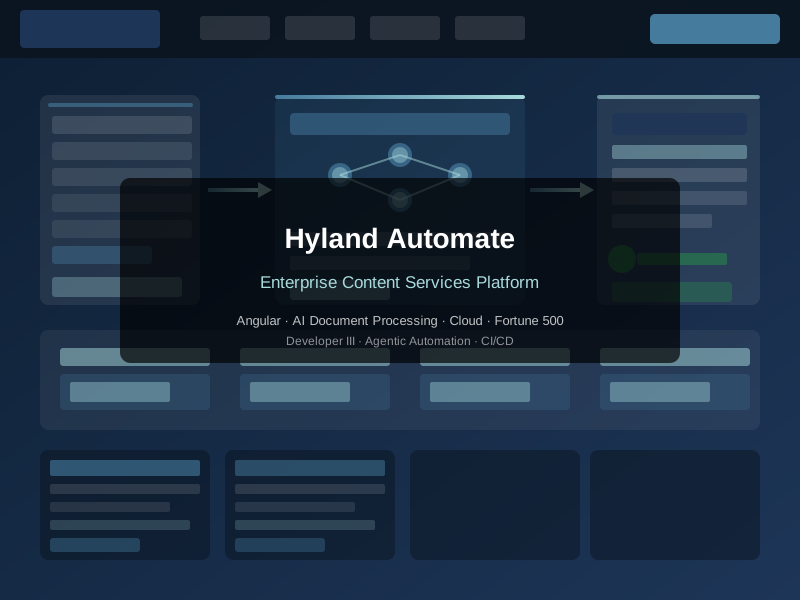
Hyland Automate — Agentic Document Intelligence

Enterprise · Hyland Software

Building agentic AI features inside Hyland Automate, a content services platform used by Fortune 500 companies. Users create workflows and applications through natural language prompts; the agentic layer interprets intent and generates low-code configurations automatically.

  • Natural-language-to-workflow generation via agentic AI
  • Document categorization, extraction, and classification at enterprise scale
  • Confidence scoring and human-in-the-loop patterns for edge cases
  • Intelligent search across enterprise document repositories
  • Multi-step reasoning workflows with tool-use / function calling
Agentic AI.NET CoreAngularLLM IntegrationDocument Intelligence
🔀

LLM Proxy Server — Multi-Provider Architecture

Personal Project · Production

A production-grade .NET Core proxy that provides a unified API surface over seven LLM providers. Routes requests to the most cost-effective model for each task with real-time cost tracking and quota management.

  • Unified API over OpenAI, Anthropic, Azure AI Foundry, AWS Bedrock, and Groq
  • Real-time cost tracking and spend visibility per request
  • Intelligent routing — selects optimal model based on task type and cost
  • Rate limiting, quota management, and provider-level fallback
  • Request/response logging with full audit trail
OpenAIAnthropicAWS BedrockAzure AI FoundryGroq.NET Core
🤖

Portfolio AI Assistant

Personal Project · Live on this site

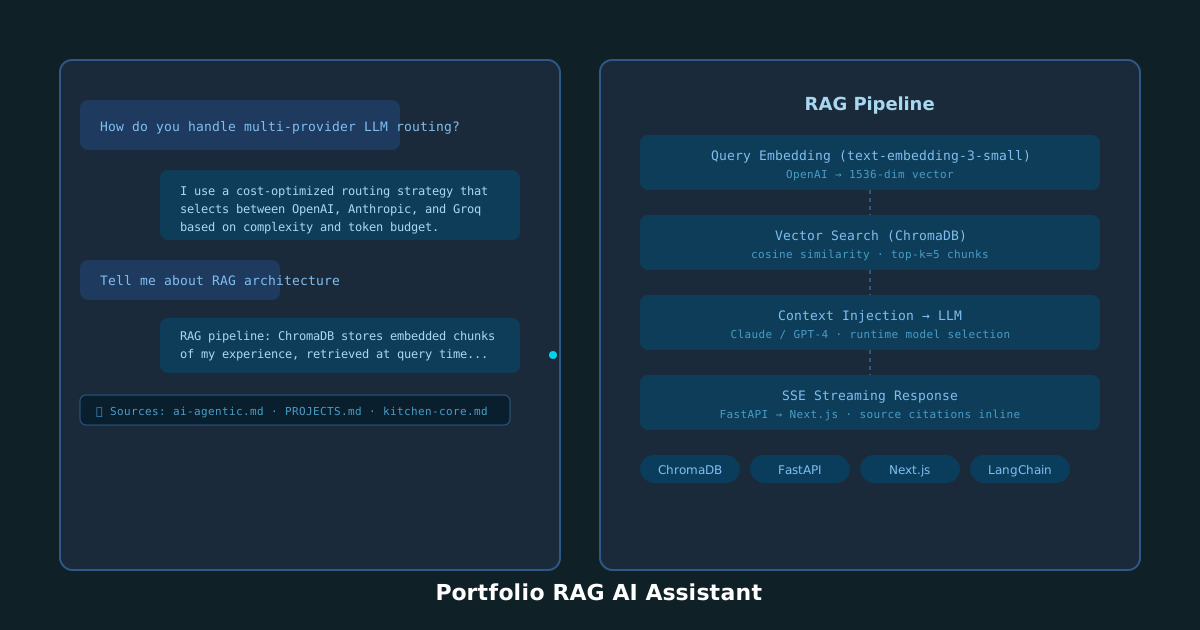
The AI chatbot powering this portfolio. Built with Next.js and the Vercel AI SDK, it uses a RAG pipeline backed by a Python/FastAPI service with ChromaDB for vector search. Supports multiple conversation modes — technical deep-dive vs. quick hiring overview.

  • RAG pipeline: personal knowledge base + vector search via ChromaDB
  • Multi-model support: switches between Claude and GPT-4 at runtime
  • Conversation mode switching for different audience contexts
  • Streaming responses with typing indicators
  • Source citations surfaced inline in chat responses
Next.jsVercel AI SDKChromaDBPythonFastAPIRAG
⚙️

Agentic Development Pipeline

Production Workflow · Used across all projects

A ticket-to-PR automation system that runs parallel Claude Code agents in isolated git worktrees. Each agent works an independent ticket simultaneously — dependency analysis determines phases, preventing conflicts while maximising throughput.

  • Linear ticket → dependency analysis → phased prompt generation
  • Parallel Claude Code agents in isolated git worktrees — zero conflicts
  • Two deployment variants: GitHub Actions ($0/mo) vs n8n on VPS (~$10/mo)
  • CLAUDE.md governance: 17 rules, 55 skills, per-directory AGENTS.md
  • Automated verification: build, test, lint, and pattern compliance
  • Auto-merge configurable at three levels: none / create / merge
Claude CodeLinearGitHub Actionsn8nGit WorktreesMCP

Development Methodology

How workspace governance and agentic orchestration power every project shipped.

55Skills
17Governance rules
3,924Indexed symbols
4Pipeline steps

Workspace Governance

Every repo in the workspace is governed by a CLAUDE.md containing 17 rules that every AI agent must follow — git worktree isolation, auto-documentation triggers, pattern discovery order, and validation gates. Sub-directories carry their own AGENTS.md with local rules, and docs/contracts/ holds pattern contracts so agents write code that matches the existing codebase exactly.

The 4-Step Pipeline

1
create-promptLinear tickets → dependency graph → phased prompt file
2
scaffoldInject real file paths, code snippets, and verification commands
3
orchestrateSpawn parallel agents per phase · each in an isolated git worktree
4
verifyBuild · test · lint · pattern compliance · auto-merge or PR
💬

Try the AI Assistant

Ask me anything about my AI work, architecture decisions, or how I could help with your project. The assistant uses RAG over my actual experience and project history.

⌘Kto open from anywhere

AI Tech Stack

LLM providers, vector databases, frameworks, and tooling I work with regularly.

🧠OpenAILLM Provider
🔮AnthropicLLM Provider
☁️AWS BedrockLLM Provider
🏢Azure AI FoundryLLM Provider
GroqLLM Provider
🔗Vercel AI SDKFramework
🗄️ChromaDBVector DB
🐍PythonBackend
🏗️.NET CoreBackend
📊pgvectorVector DB
🔧LangChainPatterns
✍️Prompt EngineeringSkill
🚀FastAPIBackend
📱Expo / React NativeMobile
👁️Tesseract OCRDocument AI
🔤spaCyNLP